
Executive Summary
Switzerland stands at a decisive moment in its energy transition. A nation known for engineering precision, neutrality, and economic stability now faces a paradox: an increasingly renewable grid that produces more power than it can use at certain moments – and not enough at others. The result is energy waste through curtailment, a growing loss of potential revenue, and a missed opportunity for strategic independence.
Today, well over 200 GWh (up to 660GWh in latest estimates) of renewable electricity is curtailed annually – value that disappears as turbines idle and inverters throttle – equating to tens of millions of francs at wholesale prices. This unused energy could instead power a new class of flexible digital infrastructure: data processing that responds to real-time grid conditions and turns temporary surpluses into productive output. Deployed next to renewable assets, these systems absorb surplus energy within seconds, offering a precise tool for matching supply and demand. Among them, Bitcoin mining – built on proof of work – is already operating worldwide as a capex-lean, modular, rapidly deployable, geo-agnostic way to monetize power, uniquely suited to on-off duty cycles without losing work.
Evidence from early deployments and scenario analysis indicates that asset owners who integrate flexible compute can lift EBITDA by meaningful margins – often mid-teens to low-thirties percent in conservative cases, and higher where surplus profiles, hardware efficiency, and heat reuse are favorable. The mechanism is straightforward: monetize surplus electricity rather than waste it, add a controllable load that supports grid stability, and do both without new subsidies or major rule changes.
For Switzerland, the approach aligns energy security, industrial competitiveness, and climate goals. It offers government a durable tax and employment base, businesses a path to higher margins and energy efficiency, and communities the ability to reuse otherwise wasted heat. Turning energy waste into industrial advantage can anchor Switzerland’s next phase of re-industrialization – rooted in sovereignty, precision, and pragmatic innovation.
Switzerland's Energy Paradox
Switzerland operates one of the world’s most reliable power systems [1]. Yet it increasingly faces intermittent abundance: hours when clean generation exceeds what the grid can absorb at that location. Two safety valves manage this:
Curtailment: intentionally reducing renewable output to protect equipment and balance the system. Redispatch: re-routing or re-scheduling generation to relieve constraints[2]. Both keep the 50 Hz system safe. Both also destroy economic value.
Three pain points recur across projects:
Wasted value
In an average recent year, over 200 GWh, up to 660GWh in latest estimates, of clean electricity is curtailed [3],[4]. At wholesale prices, that is tens of millions of francs in foregone revenue. The opportunity cost is higher when we factor in slower capacity build-out and the lost chance to develop local industry around surplus power.
Local bottlenecks
Many constraints are stubbornly local: valley substations, alpine passes, municipal feeders. Transmission upgrades are slow; storage assets are often too small, already committed, or uneconomic for the specific duty cycle. Moving every surplus electron to distant load centers is neither fast nor cheap. Monetizing a portion on site is often both.
Bankability and project pace
Developers and lenders must price the risk that a plant cannot deliver expected energy in certain hours. That revenue volatility lowers debt capacity, raises financing costs, and delays commissioning – even for projects that make sense on a national balance sheet.
Policy rightly focuses on transmission and storage. But both are capital-intensive and time-consuming. Switzerland needs an additional tool that turns intermittent abundance into local value now – without waiting years for new steel in the ground. Flexible compute, with Bitcoin mining as today’s most mature example, provides that tool.
The 50 Hz Constraint and Today's Toolbox of Managing It
The grid must hold frequency near 50 Hz. When generation exceeds demand at a given node, frequency rises; when demand exceeds generation, it falls. Operators orchestrate tools across time horizons to keep balance. Many are excellent – but few can sit at a congested node, drop to zero instantly without losing work, and monetize short, irregular surplus windows.
Current instruments at a glance:
| Instrument | Response speed | Best use | Key limit |
|---|---|---|---|
Pumped hydro | Seconds–minutes | Shifting energy across hours/day | Geography & permitting; long lead time |
Batteries | Sub-second–seconds | Fast frequency response; short congestion relief | High cost per kWh; limited duration |
Fast-start thermal | Minutes | Longer ramps, scarcity events | Fuel cost & emissions; policy exposure |
Imports/exports | Minutes | Cross-border balancing | Interconnector limits; price volatility |
Industrial demand response | Minutes–tens of minutes | Pre-agreed curtailments | Process & comfort constraints |
Building automation/heat pumps | Minutes–hours | Weather-driven load shifting | Slow response vs. instant needs |
EV smart charging | Minutes–hours | Valley filling; mid-day solar when cars present | User behavior, uneven geography |
Electrolyzers | Seconds–minutes | Large steady surpluses in hubs | High capex; needs dependable offtake |
Curtailment/redispatch | Seconds–minutes | System safeguard of last resort | Destroys value |
What’s missing: A grid-native demand that (1) lives at the constraint, (2) ramps down to zero and back up in seconds, (3) loses no work when interrupted, and (4) earns revenue from short, irregular windows without disrupting industrial processes or human environments.
What Is Flexible Compute and Why Bitcoin Mining Leads
Flexible compute is data processing that matches local electricity in real time. It can pause instantly, resume instantly, and doesn't lose progress when interrupted. Even a few minutes of surplus can be turned into productive work. Next to a renewable plant, flexible compute becomes a grid-native demand resource: it takes power when the system has too much and disappears when the system needs headroom—without breaching comfort limits or interrupting critical processes.
Why Bitcoin mining is today's leading example
Bitcoin mining converts electricity into a standardized digital output and earns a continuous reward. If machines stop mid-calculation, no progress is lost; they simply restart later. The gear is modular (in increments of 0.5MW blocks), site-tolerant (modest connectivity, simple cooling), and fast (seconds-level response). This makes mining unusually well-suited to edge-of-grid, curtailment-first duty [5].
Bitcoin Mining vs. alternative demand-side measures:
| Attribute | Batteries | Ind. demand response | Electrolyzers | Flexible compute (Bitcoin Mining) |
|---|---|---|---|---|
Response | Sub-second–seconds | Minutes | Seconds–minutes | Seconds |
Lost work when interrupted | n/a | High | Medium | None |
Deployment scale | Site–regional | Site–regional | Industrial hubs | Modular, node-level |
Geo constraints | Low–medium | Low–medium | Medium–high | Very low |
Primary limit | Duration/cost | Process/comfort | Offtake/economics |
Market conditions + ops discipline | Positioning: Flexible compute does not replace hydro, batteries, or demand response. It slots into the same control stack, occupying the ultra-short-notice window where other options are unwilling, uneconomic, or technically unable to move.
The Optimal Operating Model in Switzerland
Regulatory and market fit Switzerland already defines standards for telemetry, responsiveness, and data quality. The Transmission System Operator procures readiness and activations from qualified resources. Distribution System Operators enforce local limits. Aggregators can pool modules. Independent verifiers certify data integrity and performance. Containerized compute that meets these standards participates on non-discriminatory terms. No special carve-outs are required [6],[7].
Connection on site
A containerized unit is wired like any controllable resource at a plant or substation. Schedules are time-aligned, telemetry is high-fidelity, and logs are complete for ex-post checks.
- When awarded capacity in reserve services, the unit prioritizes availability and follows activation instructions precisely [8].
- When not awarded, it runs curtailment-first behind the meter, absorbing surplus minutes and backing off instantly on constraint signals.
Revenue lines:
- Readiness payments for standing prepared in reserve services.
- Activation payments when the system calls for up- or down-regulation.
- Behind-the-meter surplus monetization when not in service awards.
- Hash-linked earnings while operating, within the same operating envelope.
Separating these lines diversifies cash flow and clarifies risk for boards and lenders.
Assurance and governance
Behavior sits inside a software-enforced envelope (ramp rates, response windows, maximum draw). Instant pause/resume means no backlog of unfinished work. Standard switchgear and telemetry make performance observable. Third-party verification confirms availability, delivery, and data quality.
Technical fit at the edge
Edge locations near small hydro or alpine solar rarely have redundant fiber or large cooling. Miners tolerate frequent on-off cycles, run with modest connectivity, use straightforward cooling, and can be installed, expanded, or removed with limited civil works. If feeder conditions improve or markets change, modules can be scaled down or redeployed.
Economic magnitude and underwriting
Outcomes hinge on four factors: (1) surplus shape and frequency, (2) hardware efficiency and capex/MW, (3) site OPEX and (4) and Bitcoin market conditions. Conservative Swiss-like cases often yield mid-teens to low-thirties percent EBITDA uplift, forties to sixties can occur with frequent surplus, efficient hardware, and heat reuse. Higher results are exceptional. Use sober base cases, disclose assumptions, and run sensitivities [9].
Practice within Swiss processes
The Transmission System Operator buys readiness and activations. The Distribution System Operators manage local constraints. Asset owners operate within documented envelopes and ultimately, verifiers attest to data. Flexible compute follows the same control signals and audit paths as other controllable loads, with a unique property at congested nodes: it can appear in surplus minutes and vanish in seconds without comfort or process penalties.
What Switzerland Should Do Now: A Practical, Multi-Stakeholder Pilot
We propose to launch a small set of open, technology-neutral pilots at sites with proven curtailment or recurring low-price hours. Test flexible compute alongside other controllable demand so results are fair, comparable, and useful to policymakers, grid operators, plant owners, lenders, and communities.
How we'll run it:
- Level playing field: identical rules and access for all technologies [10].
- Use existing Swiss processes: qualification, telemetry, auditing—no new bureaucracy.
- Same paperwork, same clock: shared reporting templates and timelines.
- Public visibility: simple live dashboards during the year and a clear 12-month report [11].
What we'll measure:
- Reliability: Were units available when promised? Did they deliver when called, how quickly, and were there penalties?
- System value: How many MWh of curtailment were avoided? How much reserve capacity was awarded? Is the data complete and on time?
- Economics: What came in from readiness, activations, and surplus monetization? What did telemetry and maintenance cost? What assumptions were used?
- Local integration: Are sound levels within limits? How much useful heat reached nearby pools, greenhouses, or public buildings? Is there an easy public log of questions and answers [12]?
Heat reuse—make the benefit visible
Treat heat reuse as a public good. Enable straightforward hookups to pools, greenhouses, public buildings, and light industry. If a pilot warms a pool or a winter greenhouse with energy that would have been wasted, people see the value immediately [13].
What success looks like:
- Less curtailment at the tested sites
- Reliable participation in reserve services
- Useful heat delivered to local facilities [14]
- Better project economics for asset owners
All benchmarked against alternatives and validated on Swiss terms—so we scale what works and stop what doesn't.
What You can Do to Act: A Stakeholder Call to Action
If you hold legislative or regulatory authority
You want more energy sovereignty without new subsidies and you are protective of reliability. The practical step is to clarify eligibility: containerized, controllable loads that meet technical and environmental standards participate on non-discriminatory terms. Publish a short siting and permitting note for generation-site deployments (ramp/response windows, maximum draw, sound limits, thermal exhaust management, reporting). Require pilots to follow the common measurement framework and publish results on schedule.
Help to achieve the outcome of less curtailment becomes taxable industrial output and skilled jobs, while the grid keeps its high standard.
If you run a power plant, develop projects, invest, or lend
You want steadier cash flow and better use of assets. Start where physics helps you: sites with recurring curtailment or low-price hours. Size modular units to absorb only a portion of surplus to stay flexible. Keep revenue lines separate and auditable. Underwrite with conservative assumptions (efficiency, capex/MW, OPEX, market conditions). Engineer for community acceptance from day one (acoustics, siting, local heat plan with visible beneficiaries).
Help to achieve the outcome of turning wasted minutes into value without compromising mission or reputation.
If you represent a municipality, cooperative, or community
You want cleaner air, useful local heat, and honest reporting. Offer a time-bound social license when projects meet clear conditions: responsible siting away from homes, strict sound limits, public dashboards showing energy use, availability, delivery when called, curtailment avoided, and heat delivered; plus a simple channel for questions and resolution. Ask for practical benefits first—pools, greenhouses, public buildings. Support projects that deliver; close those that do not.
Help to achieve the outcome of securing the public confidence by providing measurable community benefits.
Synthesis: Energy Sovereignty, Industrial Depth, Environmental Integrity
Energy sovereignty
Managing energy abundance is now as important as managing energy scarcity. Using surplus renewable power at home—instead of exporting at volatile prices or wasting it—raises autonomy. Grid-native compute and Bitcoin mining in particular localizes both energy use and value creation. Because the load is controllable and instant, it appears and disappears exactly when the grid needs room.
Industrial depth
By adding a controllable revenue stream at the plant, flexible compute turns wasted minutes into income. This makes projects more attractive to private capital without new subsidies, supports skilled work in electrical engineering, software control, and operations, and encourages heat-reuse industries (greenhouses, light manufacturing, pools, public buildings).
Environmental integrity
When waste heat is piped into useful applications, communities see a visible benefit: less fossil heat, lower bills, and better public facilities. This is not a paper offset; it is real warmth where people live and work.
Swiss character, applied
Precision, neutrality, and reliability can shape the country's digital-energy future as much as they shaped its mechanical past. With clear operating envelopes and transparent reporting, grid-native compute, led today by Bitcoin mining, gives Switzerland a tool that balances complexity with simplicity and delivers measurable results.
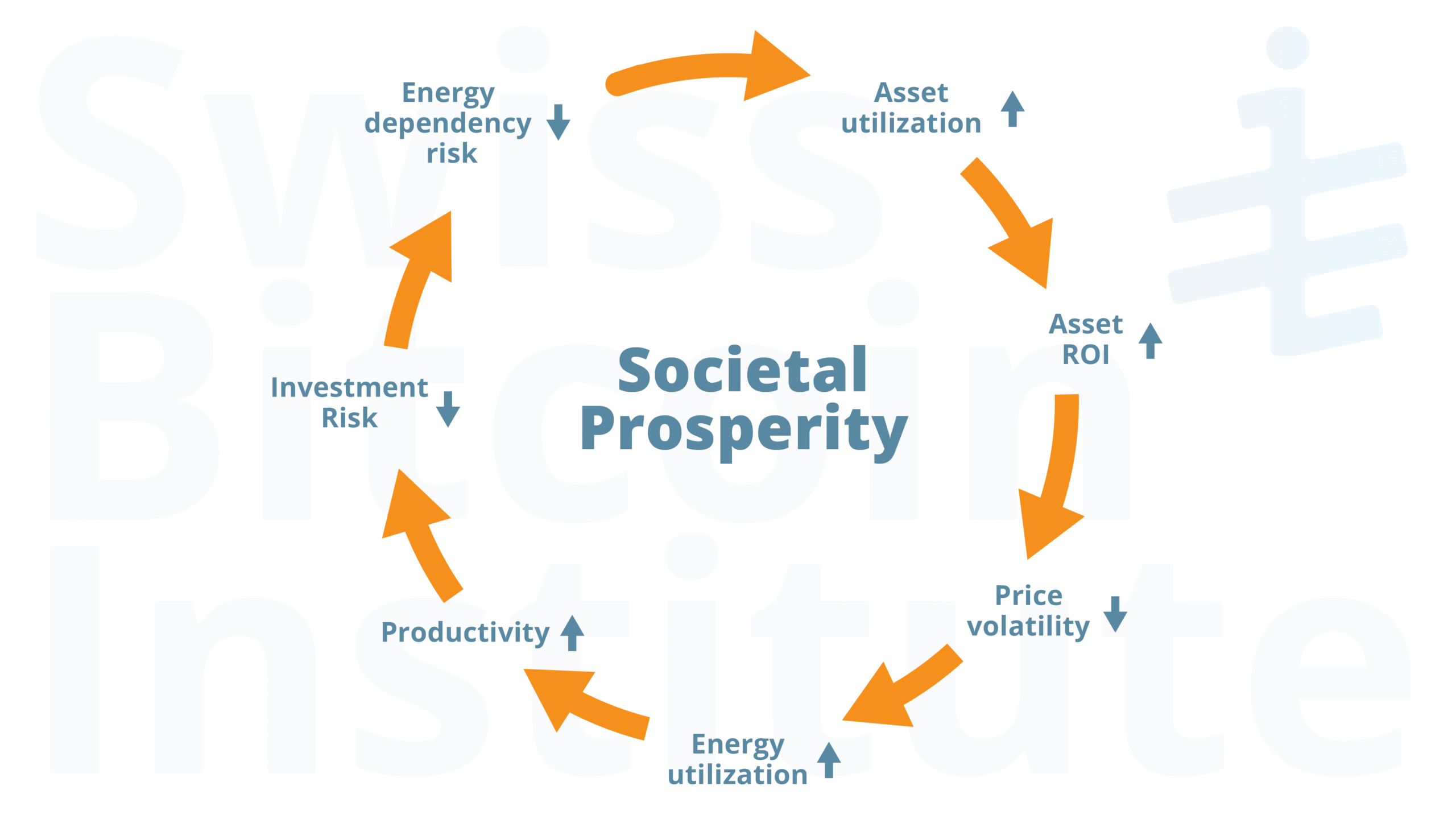
Figure 1: Social Prosperity Flywheel
Conclusion
Switzerland’s challenge is not just to add clean generation but to manage abundance in ways that create value at the source. Bitcoin mining, as the most mature form of flexible compute, does exactly that: it converts surplus clean power into digital value and, where captured, usable heat. The operating principle is disciplined and simple: compute when the grid cannot absorb power; stand down when it can. With clear guardrails and honest reporting, this reduces curtailment, strengthens plant economics, and supports a more stable grid.
The prize is straightforward. Switzerland can retain more energy value at home, give its regions a modern industrial activity that fits their geography, and show how sovereignty, sustainability, and prosperity reinforce one another in practice. By engaging with grid-native compute and Bitcoin mining on Swiss terms, measured, transparent, and fair, the country turns energy abundance from a problem to manage into an advantage to master and a catalyst for broad societal prosperity.
References
- Swissgrid: Annual Report 2024. Report. 16.04.2025. https://www.report.swissgrid.ch/en/ (PDF: "Swissgrid Annual Report 2024").
- Swissgrid: Redispatch – Web page. https://www.swissgrid.ch/en/home/customers/topics/redispatch.html
- National curtailment figure not officially published. Value stated is an estimate expressed as a moving average over several years based on available data.
- Swissgrid: "Redispatching: when the grid comes under pressure." 16.04.2025. https://www.swissgrid.ch/en/home/newsroom/blog/2025/when-the-grid-comes-under-pressure.html
- ERCOT: Ancillary Services Study, Final White Paper. 07.10.2024.
- Swissgrid: Ancillary Services: Principles of AS Products (V20). Product description. https://www.swissgrid.ch/en/home/customers/topics/ancillary-services/as-documents.html
- Swissgrid: Prequalification for ancillary services. Web page. Updated regularly. https://www.swissgrid.ch/en/home/customers/topics/ancillary-services/prequalification.html
- Swissgrid: Tenders for ancillary services (results & downloads). Web page/CSV. Updated regularly. https://www.swissgrid.ch/en/home/customers/topics/ancillary-services/tenders.html
- Menati, A.; Lee, K.; Xie, L. — "Modeling and analysis of utilizing cryptocurrency mining for demand flexibility…" IEEE/ArXiv (preprint: arXiv:2207.02428). 2023–2024
- smartEn (Smart Energy Europe): The smartEn Map 2024: Participation of Demand-Side Flexibility in European markets. Report (PDF). 2024/2025. https://smarten.eu
- Swissgrid: Energy data CH: transparency dashboards. https://www.swissgrid.ch/en/home/customers/topics/energy-data-ch.html
- Fedlex: Lärmschutz-Verordnung (LSV)(Swiss Noise Abatement Ordinance). Consolidated text. https://www.fedlex.admin.ch/eli/cc/1987/338_338_338/de
- Euronews Green: "Geneva's homes will be heated by recycled energy from this Swiss data centre" (Infomaniak heat-reuse project). 30.01.2025. https://www.euronews.com/green/2025/01/30/genevas-homes-will-be-heated-by-recycled-energy-from-this-revolutionary-swiss-data-centr
- Data Center Knowledge: "Data center used to heat swimming pool" (Uitikon/IBM/GIB Services, Switzerland). 07.04.2008. https://www.datacenterknowledge.com/cooling/data-center-used-to-heat-swimming-pool