
Executive Summary
The past year has been transformative for the emerging Bitcoin treasury movement. After a period of exuberant growth, driven by rising markets, bold corporate experiments, and attempts to replicate Strategy₿'s early successes, the sector faced its first genuine stress test in mid-2025. Companies that grew cautiously and transparently proved far more resilient, while those relying on aggressive or speculative capital structures encountered heightened volatility, liquidity shocks, and in some cases, forced Bitcoin liquidation.
The lesson for leaders is stark: the difference between speculative capital and strategic capital is the difference between fragility and durability. This article introduces a practical framework for understanding the maturation of Bitcoin treasury companies and provides a structured lens for executives evaluating whether, when, and how to adopt a Bitcoin-centered balance-sheet strategy.
Introduction
"The easy money is the toxic money." Michael Saylor
For any organization considering a Bitcoin treasury strategy, the past year offers both a warning and a roadmap. The question is no longer whether a company can raise capital to accumulate Bitcoin, many have already done so. The real question is whether it can do so in a way that strengthens, rather than undermines, long-term corporate stability.
The events of summer 2025 make this distinction clear. After a year of enthusiasm and rising valuations, the sector hit a hard reset as seasonal weakness, share unlocks, and poorly structured financings converged. What happened next separated strategic execution from speculative shortcuts.
To understand how the market reached that point, we must return to where the playbook began.
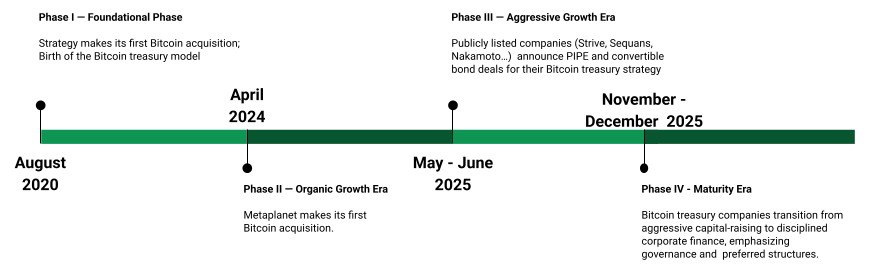
Figure 1: Phases in the Evolution of the Bitcoin Treasury Ecosystem (2020–2025)
Figure 1 illustrates the four major phases in the development of the Bitcoin Treasury ecosystem, from Strategy₿'s pioneering adoption in 2020 to the maturity phase emerging in late 2025. These phases frame the strategic choices companies face today.
1. The Strategic Question: Why Bitcoin Treasuries?
Bitcoin treasuries emerged from a simple but profound corporate question: How should an organization preserve and grow its capital in an environment of monetary debasement and rising asset inflation?
The modern model began in August 2020, when Strategy₿ became the first public company to adopt Bitcoin as its primary treasury reserve asset (see prior article SBI-001). What began as a diversification experiment evolved into a transformational capital-markets strategy, one that reframed Bitcoin not as a speculative asset, but as a form of strategic corporate capital.
Why do organizations consider Bitcoin as a strategic reserve asset?
Companies pursue Bitcoin treasury strategies for several reasons:
- Monetary protection against persistent inflation
- Balance-sheet resilience, especially for companies with excess cash or limited yield opportunities
- Shareholder alignment through disciplined, transparent capital allocation
- Improved access to capital markets, as Bitcoin-based credibility expands financing options
- A shift from defense to offense in M&A, enabling a company to act as an acquirer rather than a target
Strategy₿'s success stemmed from credibility earned step-by-step. It deployed excess cash, timed capital raises carefully, issued convertible bonds, and eventually introduced perpetual preferred equity, structures that worked only because of its scale, liquidity, and credibility.
Imitators soon discovered that copying the tools without the discipline merely amplified risk.
2. Two Paths Diverge: Organic vs. Aggressive Growth
As the Bitcoin treasury movement expanded, two distinct approaches emerged. One was disciplined, methodical, and transparent. The other sought rapid scale through aggressive financings.
The divergence between these paths explains much of the sector's resilience and its fragility during the 2025 correction.
2.1 The Disciplined Path: Metaplanet, Capital B, and SmarterWeb
A quieter group of companies advanced through deliberate, structurally sound strategies. Starting with modest foundations, Metaplanet (Japan), Capital B (France), and SmarterWeb (United Kingdom) built meaningful Bitcoin treasuries in short order, each with a different mechanism, but unified by disciplined execution and strong market premiums.
Metaplanet adopted a measured approach anchored in governance and stability. Partnering with EVO Funds, it introduced a moving-strike warrant program (similar to an at-the-market (ATM) issuance in the U.S.) enabling gradual accumulation aligned with market conditions.
It complemented this with short-term debt structured around disciplined repayment schedules and deployed cash-secured puts to generate incremental yield without compromising downside protection.
Capital B followed a similarly structured playbook. Through its partnership with TOBAM, it launched an ATM-style capital program, raising funds only when markets were favorable. It also issued the first-ever Bitcoin-denominated convertible bonds, aligning its liabilities directly with its reserve asset.
This was not leverage for its own sake, it was financial engineering used to reinforce the treasury and maintain long-term alignment with Bitcoin among both shareholders and bondholders.
SmarterWeb employed a more organic model, relying primarily on operational profits and share premiums to scale its treasury transparently and consistently.
Table 1 illustrates how disciplined Bitcoin treasury companies achieved substantial Bitcoin accumulation without aggressive financing structures. Beginning with modest purchases, they translated credibility, structured programs, and steady execution into outsized growth.
| Company | Metaplanet | Capital B | SmarterWeb |
|---|---|---|---|
Date of first purchase | Apr 23, 2024 | Nov 5, 2024 | Apr 28, 2025 |
Initial BTC Acquisition | 97.85 | 15 | 2.3 |
BTC Holdings (as of Nov 16, 2025) | 30'823 | 2'818 | 2'664 |
Increase Since First Purchase (BTC) | 30,725.15 | 2,803.00 | 2,661.70 |
Increase Since First Purchase (%) | ~31'400% | ~18'687% | ~115'726% |
Table 1: Growth of Bitcoin Holdings Among Disciplined Bitcoin Treasury Companies
What unites these companies:
- Structural discipline took priority over speed
- Financing tools were matched to liquidity realities
- Shareholder trust was earned through transparent communication
- Balance sheets remained pristine, providing strategic optionality
For a Bitcoin treasury, a clean balance sheet is not a luxury, it is the core strategic asset that enables defensive durability and offensive M&A capability.
2.2 The Aggressive Path: PIPEs and Convertible Bonds
While disciplined companies grew steadily, a new wave of companies, motivated by Strategy₿'s headlines, sought to scale rapidly, often without the liquidity, credibility, or structural resilience required to support such expansion.
The first tool many companies turned to was the PIPE (Private Investment in Public Equity). PIPEs offer speed and flexibility by selling newly issued shares directly to private investors. But they carry meaningful trade-offs:
- discounted share prices
- regulatory delays before shares become tradable
- unlock events that flood thin markets with new supply
These mechanics frequently generated sustained selling pressure.
The second tool often paired with PIPE financing was the convertible bond. Convertible bonds were central to Strategy₿'s early rise. For large, liquid companies, they deliver low-cost capital and long-term flexibility.
But for smaller companies, investor hedging (often through short-selling) can overwhelm natural demand and produce mechanical downward pressure.
Many newcomers adopted these tools to signal ambition, not to execute a coherent plan. The result: enhanced volatility and diminished credibility.
Companies like Sequans, Nakamoto, and Strive did accumulate large initial Bitcoin positions, but the scale came with consequences: fragility, volatility, and in some cases, forced selling.
Table 2 shows that while aggressive financing tools can accelerate the initial accumulation of Bitcoin, they also produce highly divergent outcomes. Companies without sufficient liquidity, market credibility, or strategic discipline often find that these instruments impose constraints rather than create opportunities, ultimately allowing the structure to control the company instead of empowering it.
| Company | Sequans | Nakamoto | Strive |
|---|---|---|---|
Financing Tools | PIPE<br/>Convertible bonds | PIPE<br/>Convertible bonds | PIPE |
Date of first purchases | Jul 10-28, 2025 | May 27-Aug 19, 2025 | Sep 12-14, 2025 |
Initial BTC Acquisition | 3'075<br/>5'765 | 5'885 | 7'525 |
BTC Holdings (as of Nov 16, 2025) | 2'264<br/>5'765 | 5'765 | 7'525 |
Increase Since First Purchase (BTC) | -811 | 0 | 1'640 |
Increase Since First Purchase (%) | -26.38% | 0% | 27.87% |
Table 2: Bitcoin Accumulation Outcomes for Companies Using PIPEs and Convertible Bonds
Aggressive tools are not inherently flawed but they require liquidity, credibility, and strategic clarity. Without these, the instruments end up controlling the company.
Whichever path a company chose, the conditions were already in place for what came next.
3. When the Music Stopped: The 2025 Bitcoin Treasury Correction
By early summer, the Bitcoin treasury sector appeared unstoppable. Optimism was relentless, valuations surged, and new adopters entered the market at a rapid pace. Small-cap companies traded at multiples far exceeding what was justified.
Then reality returned. Sentiment weakened. Valuations that once looked visionary now seemed overstretched. Seasonal risk-asset weakness collided with the first PIPE unlocks.
Suddenly, previously tightly held shares became liquid, supply cascaded into thin markets, early investors locked in profits, and structurally fragile companies were hit by mechanical selling pressure.
What had fueled the rally now accelerated the downturn.
By late summer, almost every Bitcoin treasury company had slowed accumulation or paused entirely. Companies with clean balance sheets entered defensive mode, waiting out the turbulence.
Sequans: A Case Study in Structural Overreach
After expanding aggressively through a PIPE and a convertible bond issuance, Sequans was able to continue accumulating Bitcoin but soon found itself overextended. Just months later, it was forced to sell 970 BTC to redeem half its notes, becoming the first meaningful Bitcoin treasury to reduce holdings. Rapid expansion without structural resilience turns strategy into liability.
4. Scale as Strategy: When Aggressive Growth Makes Sense
As Pierre Rochard, CEO of Bitbond and Board Member of Strive, noted:
"When we pool our capital in a Bitcoin treasury company, we gain access to better credit terms than any of us could individually. The sum becomes greater than the parts."
This highlights a critical principle: the long-term opportunity lies not in hype, but in collective scale and credit efficiency.
PIPEs and convertible bonds were never meant as shortcuts; they were intended as bridges to institutional scale. Their effectiveness depends entirely on execution.
A few companies recognized that responsible scaling was essential to unlocking more sophisticated and lower-cost forms of capital. Metaplanet and Strive illustrate this more strategic use of aggressive tools.
Metaplanet's PIPE-like raise in September was difficult, the stock was shorted ahead of the deal, but it ultimately expanded the company's holdings by 53% (from 20,136 BTC to 30,823 BTC). That increase, while painful in the short term, positioned Metaplanet to enter its next phase: issuing preferred shares.
Strive followed a similar logic. By completing a reverse merger and a PIPE, it reached the scale necessary to pursue preferred equity while deliberately avoiding convertible bonds to preserve balance-sheet integrity. As a result, Strive is now one of only two companies, alongside Strategy₿, to successfully issue preferred shares.
When executed correctly, scaling is not speculative, it is strategic infrastructure building.
5. The Road Ahead: Toward a Mature Bitcoin Corporate Finance Ecosystem
The 2025 correction drew a bright line between speculative and strategic capital. The next phase of Bitcoin treasury development will not reward companies with the most Bitcoin, it will reward those who manage their treasuries with structural sophistication, transparency, and resilience.
Pierre Rochard highlighted an important truth:
"The PIPE exists as a workaround… not because it's the best form of financing, but because it's often the only one available within regulatory constraints."
The Bitcoin treasury sector is still early. The financial infrastructure is immature. But just as Strategy₿ worked with regulators and institutions to pioneer new tools and frameworks, the next wave has the opportunity, and responsibility, to innovate as well.
This evolution will not be U.S.-only. Jurisdictions worldwide will need frameworks for Bitcoin-aligned corporate finance. Metaplanet's moving-strike warrant program demonstrates the potential unlocked when companies pair disciplined execution with creative financial innovation.
The future of the Bitcoin treasury ecosystem will depend on financial creativity grounded in discipline, long-term alignment, and constructive regulatory engagement.
A Leadership Checklist
Executives exploring a Bitcoin treasury strategy should:
- Define their purpose: What problem is the strategy solving?
- Assess current circumstances: Balance-sheet strength, liquidity, market conditions, regulatory environment.
- Evaluate available tools: Which financing mechanisms can be used responsibly and sustainably?
- Determine which path fits their identity.
- Organic growth? Strategic scaling? Hybrid approaches?
The coming cycle will reward corporations that raise capital transparently, manage risk prudently, and maintain the trust across shareholders, lenders, and regulators.
Conclusion: Choosing the Right Capital Strategy
Strategy₿'s philosophy was articulated clearly in its Q3 2025 earnings call, when Michael Saylor stated:
"We would rather coast and have a bulletproof balance sheet… than chase yield that undermines it. We want to be the company that provides a comfortable retirement to a billion people, and changes the monetary system."
This reframes the purpose of a Bitcoin treasury strategy. It is not about leverage or volatility. It is about building long-term strategic strength:
- monetary protection
- resilient balance sheets
- shareholder alignment
- improved access to capital
- the ability to play offense in M&A
Above all, it is about bridging Bitcoin's monetary ethos with corporate finance discipline, proving that growth and structural integrity can coexist.
As the sector matures, the companies that internalize this discipline will outlast the hype. They will shape a new financial paradigm, one defined not by easy money, but by durable capital, measured execution, and strategic clarity.
The era of easy money is ending. The age of durable capital has begun.
References
- Strategy₿. "MicroStrategy Completes $1.05 Billion Offering of Convertible Senior Notes." February 19, 2021. Accessed October 12, 2025. https://www.strategy.com/press/microstrategy-completes-1-05b-offering-of-convertible-senior-notes_02-19-2021
- Quant Bros. "Unpacking $MSTR and the Convertible Bond Market". November 20, 2024. Accessed October 12, 2025. https://www.youtube.com/watch?v=8U1JqBQ82b4
- Bitcoin Asset Research. "This Is How MSTR Convertible Bonds Make Money". December 19, 2024. Accessed October 12, 2025. https://www.youtube.com/watch?v=fQm1K0Lt7Mg&list=PL7mbuNK9knaz4Cl598Bp3kxYXR8PKYaCZ
- True North. "In the Mind of Richard Byworth with Jeff Walton". March 12, 2025. Accessed October 12, 2025. https://www.youtube.com/watch?v=_T6Wu5d3IY0
- The Hurdle Rate podcast. "The Digital Credit Landscape". October 14, 2025. Accessed November 10, 2025. https://www.youtube.com/watch?v=FM638pY34uo
- The Hurdle Rate podcast. "Strategic Risk Taking". October 22, 2025. Accessed November 10, 2025. https://www.youtube.com/watch?v=003pvQdffr4
- Strategy₿. "MicroStrategy Adopts Bitcoin as Primary Treasury Reserve Asset". August 11, 2020. Accessed November 10, 2025. https://assets.contentstack.io/v3/assets/bltf8d808d9b8cebd37/bltdc574e252ebabae5/6762eaf6fce5e8b4194e463f/form-8-k_08-11-2020.pdf#page=5&zoom=100,21,9
- Metaplanet. "Metaplanet Analytics". Accessed November 10, 2025. https://metaplanet.jp/en/analytics
- Metaplanet. "Notice of Additional Purchase of Bitcoin" October 1, 2025. Accessed November 10, 2025. https://contents.xj-storage.jp/xcontents/33500/42049202/db98/40c8/83c4/1af0a508d7a6/140120251001566267.pdf
- Metaplanet. "Scaling and Building Complementary Business Lines to Significantly Increase Perpetual Preferred Issuance Capacity". October 1, 2025. Accessed November 10, 2025. https://contents.xj-storage.jp/xcontents/33500/7eafeba0/293b/4a9f/9839/1a10520c4f72/140120251001566056.pdf
- Capital B. "The Blockchain Group announces the acquisition of 15 BTC at a cost of €0.063M for a total amount of €0.949M". November 12,2024. Accessed November 10, 2025. https://cptlb.com/wp-content/uploads/2024/11/20241112-TBG-CP-12-novembre-2024-EN-FINAL.docx-3.pdf
- Sequans. "Sequans Closes $384 Million Strategic Investment to Launch Bitcoin Treasury Initiative". July 8, 2025. Accessed November 10, 2025. https://sequans.com/sequans-closes-384-million-strategic-investment-to-launch-bitcoin-treasury-initiative/
- Sequans. "Sequans Redeems 50% of Convertible Debt Through Strategic Asset Reallocation". November 4, 2025. Accessed November 10, 2025. https://sequans.com/sequans-redeems-50-of-convertible-debt-through-strategic-asset-reallocation/
- Strive. "Strive Asset Management and Asset Entities (Nasdaq: ASST) Announce $750M Private Investment to Fund First Wave of Bitcoin Accumulation". May 27, 2025. Accessed November 10, 2025. https://investors.strive.com/news-events/news-releases/news-details/2025/Strive-Asset-Management-and-Asset-Entities-Nasdaq-ASST-Announce-750M-Private-Investment-to-Fund-First-Wave-of-Bitcoin-Accumulation/default.aspx
- Strive. "Strive Announces Proposed Initial Public Offering of SATA Stock". November 3, 2025. https://investors.strive.com/news-events/news-releases/news-details/2025/Strive-Announces-Proposed-Initial-Public-Offering-of-SATA-Stock/default.aspx
- Reuters. "Ramaswamy-backed Strive to buy Semler in $1.3 billion deal all stock deal, boosting Bitcoin holdings"- September 22, 2025. Accessed November 10, 2025. https://www.reuters.com/legal/transactional/ramaswamy-backed-strive-buy-semler-13-billion-deal-all-stock-deal-boosting-2025-09-22/
- KindlyMD. "KindlyMD Acquires 5,744 BTC to Expand Nakamoto Bitcoin Treasury". August 19, 2025. Accessed November 10, 2025. https://feeds.issuerdirect.com/news-release.html?newsid=6921634576677697&symbol=KDLY,NAKA
- One Chair Podcast. "Pierre Rochard: From MSTR to Strive — Bitcoin Treasuries, Bear Markets & Policy Battles". October 27, 2025. Accessed November 10, 2025. https://youtu.be/fUnnVIdpEko?si=OGtHFF8rfgId4SAG
- Strategy₿. "Strategy Announces Third Quarter 2025 Financial Results". October 30, 2025. Accessed November 10, 2025. https://www.strategy.com/press/strategy-announces-third-quarter-2025-financial-results_10-30-2025
